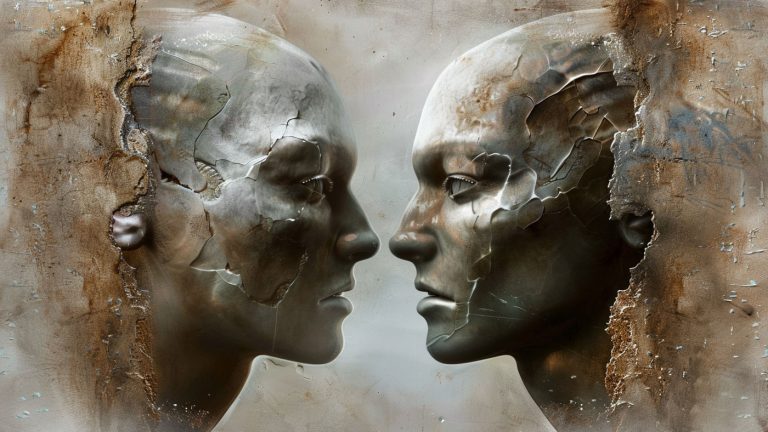
Commensurable means that scientists can discuss two theories using a shared nomenclature that allows direct comparison of theories to determine which theory is more valid or useful. The paradigm (common excepted scientific theories in a given period of time) which was admitted at the time claimed that an idea is either true or false.
In 1827, Hamilton presented a theory of a single function, now known as Hamilton’s principal function, which brought together mechanics, optics, and mathematics, and which helped to establish the wave theory of light. The theory that revolutionized quantum physics, all started by a claim which seemed irrational at the time “light is both wave and particle”.
The scientific ground at that time couldn’t accept such a claim that a thing can be both matter and energy. Light is either wave OR particle, and it can’t be both.
Feyerabend explained the impossibility of commensurable science claiming, “The problem is the result of a conflict between an expectation and an observation, which, in its turn, is formed by the expectation” (Feyerabend, 1989; pp. 96). He means that the interpretation of observations is indirectly influenced by preexisting theoretical assumptions. It is therefore impossible to describe or evaluate observations independently of past conclusions and theory. It is impossible to compare two paradigms in a meaningful way.
Kuhn claimed that “The normal-scientific tradition that emerges from a scientific revolution is not only incompatible but often actually incommensurable with that which has gone before”. Let’s break that down, what does that mean really?
Some interpret Khun’s statement as he saying, “Choices between competing scientific theories must be irrational”. The paradigm shift, according to Khun is an abrupt “sudden and unstructured event”. No one can truly reason oneself into the new paradigm built on the old one. I would say it’s like saying the Earth is flat and then Earth is round, the first cannot really be an argument for the second. Kuhn describes the process of adopting a new paradigm as a “conversion experience”, which means it can only be made on faith, maybe at least to start with until we find new tools to explain it.
Opponents to Khun’s theory of incommensurability interpret it as inappropriate as Khun makes the most taboo and unrespected claims in science when he suggests that science should be non-rational. But isn’t that is the question which every human being is faced with? And every culture, nation and collective group? Is what I believe (we believe) truth, the truth? That goes socially, politically, rationally, religiously, spiritually and emotionally? Is life what we have been taught or is or there is more to explore? How can you ever see something for what it is if you force it to fit in the prejudice you have about it?
So back to Hamilton’s theory which came to explain Newton’s particles with waves and despite the two unrelated notions (wave and particle) of the composition of matter (one being an energy and the other as being mass). Despite that his claim was impossible to understand in the light of preexisted theories, the two notions have shown that they were able to generate the same numerical result. Alfred Korzybski said “Thus, we see that one of the obvious origins of human disagreement lies in the use of noises for words”.
This essay reviewing Science, Order, and Creativity by physicist David Bohmd and writer F., discussing the role of creativity and communication for new discoveries in science. Beyond science, for humanity as a whole and societies, the authors emphasize the important of creativity in every aspects of life. The other issue they put the light on is language and how true information gets lost because of the limitation and deception of language.As in Hamilton’s theory one used to refer to particles (bodily) and wave (energy or bodiless) as unrelated notions of the constitution of matter.
Feyerabend said “the problem is the result of a conflict between an expectation and an observation”. Words can be a real issue getting between us and the nature of things. Each word we use lays an inception of expectation as for instance once you describe something as body it can’t contain energy.So I will claim that the problem doesn’t lie in the notion of the constitution of matter, it is rather in the constitution of words. The idea that something is not the thing itself. The idea that Earth is not Earth itself. That’s goes back to how our perception of the Earth has changed, but has the Earth itself changed? Earth is Earth and it hasn’t changed, the only thing which has changed is how we perceived it in our imagination over time. Energy versus particles used as an example of a paradigm shift but what if particles have always been waves and waves have always been particles and it’s only us trying to force reality into our expectations what keep us away from experiencing life more truly?
If we could experience the thing in spite of the idea of it and without words. Is that when creativity plays a critical role in us finding right answers?Alfred Korzybski emphasized that whatever we say that order is, it isn’t. “Whatever we say a thing is, it isn’t. First of all, whatever we say is words, and what we mean by what we say is not what the thing actual is, though it may be similar. For the thing is always more than what we mean and is never exhausted by our concepts. And the thing is also different from what we mean, if only because no thought can be absolutely correct when it is extended indefinitely.”
Another book I read that referred to the problem from a different perspective is “The User Illusion” by Norretrander. He explained the importance of discarded information as his leading metaphor for human communication. Norretrander compares consciousness to a concept invented by the computer scientist Alan Kay, ”the user illusion”. As we are sitting at the computer putting documents into folders or into the trash can, “the operator is under a machine-induced hallucination”. Inside the computer components there are no documents, trash cans, words or letters, just electricity engaging the ones and zeros of binary code. Instead of overwhelming the user with a flood of useless information, the computer projects a simple array of metaphors, like icons that can be manipulated to operate quickly. In a similar way, the brain, throwing away unneeded data, generates its own user illusion, the interpretation called consciousness.
A computer contains many million 0’s or 1’s. But this is nothing that the users are aware of or even need to be aware of to do their tasks. Moving from physics to psychology, more specifically the notion of consciousness and its role in our human/collective communication, he explained that it is estimated that of the millions of bits of information coming through the senses at any moment, most is thrown away. It is only a tiny part that enters into human awareness/consciousness. From this the brain creates a picture, a perception of what we mistakenly call reality. The problem of language and paradigm relies on all this information that is real but unreachable to the conscious common collective “reality”.
“Consciousness is a fraud” which takes us back to the price creativity has to pay to enter the world of consciousness. The price consciousness costs us in order to be aware is by losing the most real but unreachable experiences and picking up the small fragment that it is possible to categorise into the preexisted icons of the screen of our consciousness.
The way out of this is to be playful and to dismiss existing rules and make your own rules. Perhaps our work ethic does not consider the importance of play and suggests that work itself is noble while play is childish, unserious and unworthy, but why do we have to be serious when we try to do something meaningful?
The high cost of paradigm contra the high cost of creativity, is when we dismiss playfulness as something real in its core and we terminate creativity and innovation, just because it’s impossible to prove and it doesn’t fit in preconceptions we have. It’s out of order, the order that we hold on so hard to stay comfortable. New paradigms arise from revolution and revolution is created by rebels.
Revolutions are basically rebelling against the old ways creating new ways. When one has a “right idea in a wrong paradigm” or even “the right idea but the wrong tools to prove it” these two metaphors for me represent the high cost of paradigm. Despite how right or true a revolution is, it also pays a high cost during the time of converting believers. Sometimes it fails not because the idea is wrong, rather because there are no tools to make it accessible to the mind of those who want everything to fit into the preexisted icons on the screen of their brain. Human haven’t always been able to fly but not until recently the idea became reality through the tools of science but truly flying has been possible since the day Adam and Eve arrived, although doing it is a recent thing.
According to Bohm and Peat the current way of doing science has features that seriously discourage creativity. An established paradigm is among the most important ones because it hinders the possibility of free play of the mind in solving spontaneous questions. Scientists unconsciously “play false together” in order to defend the currently accepted basis of scientific measurement. In my understanding that also occurs because of a simple logic limitation of the tools which are used to communicate and explore any idea presented within any given paradigm. Scientific language is also a language used to communicate and not free from same illusions in other languages of cultures.
Languages build on creating a common rigidly defined world of words and symbols in order to make information exchange as clear as possible. That kills the creativity and playfulness which might give us the access to what is under the surface of the computer screen.In 2012 a famous and well established mathematician claimed to have solved the ABC conjecture problem.
This problem is claimed to be most important unsolved problem in mathematical analysis. In January 2012 the internet exploded and even the mainstream media shared the story. “World’s Most Complex Mathematical Theory Cracked” announced the Telegraph, “Possible Breakthrough in ABC Conjecture” the New York Times reported. The problem though was that the mathematic community refused to accept it, not because it was wrong but because they couldn’t understand the proof. What many mathematicians were discovering when they rushed to Mochizuki’s website, was that the proof was impossible to read.
A blogger wrote “It was not just gibberish to the average layman. It was gibberish to the math community as well”. “It’s very, very weird” wrote Columbia University professor Johan de Jong, who works in a related field of mathematics. Mochizuki had created so many new mathematical tools and brought together so many disparate strands of mathematics that his paper was populated with vocabulary that nobody could understand. It was totally novel, and totally mystifying.
Many claim that Mochizuki may have found the key that would redefine number theory as we know it. He has, perhaps, explained a new path into the dark unknown of mathematics but for now as one blogger wrote “His footsteps are untraceable. Wherever he is going, he seems to be travelling alone” http://projectwordsworth.com/the-paradox-of-the-proof/
I would say that it is impossible to escape the high cost of paradigm if we insist on a collective understanding of the world. The subjective mind is only capable of its own experience and once it has to be communicated to the other it loses its rawness and innocence. The unknown of the object is more the object rather that what we translate into the conscious device of our brain. Intuition, as the book The User Illusion explains, is where most of the data of reality exists although we can’t translate it into the conscious world but we can experience it as a sense or a feeling. This sense of unknown feeling requires attentiveness to allow creativity to arise between the unknown and the portrayal and narrative of it. Science might not understand with its shared tools but a single human would.
Paradigms are a mental state of what is agreed on to be true, not what is true. It is where belief arises through the collective mind and madness is the judgment of the individual which doesn’t fit into the one agreed on by the majority. If we manage to create a culture where we find ourselves in a continuous state of paradigm shift then and only then will creativity become the new collective language but the risk might be chaos. Incommensurable would be the legitimate new category of the world because comparison could be the trap where creativity dies.
Schopenhauer claimed that art is the only way to experience existence as it is. Music he claimed was the ultimate drug to enter that place. Schopenhauer asserts that when philosophy attempts to go any further, trying to go beyond that which is immediately presented to us in our individual consciousness, it loses its legitimacy (Schopenhauer 1969b, 640).
Literature:
- Bohm, D. & Peat, D.J. (2000). Science, Order and Creativity, 2nd London: Routledge.
- Norretranders (1991). The User Illusion, Cutting Consciousness Down to Siz.
- Sophia Vasalou, Schopenhauer and the Aesthetic Standpoint: Philosophy as a Practice of the Sublime, Cambridge University Press, 2013.